
Trading Automation: From Idea to Live Execution
Manual trading hits a ceiling fast. You miss setups overnight, hesitate when the chart moves, and execute inconsistently after a bad week. Trading automation removes the friction between your plan and the market — but only if you build it with the same discipline you'd give a production system, not a Saturday afternoon side project.
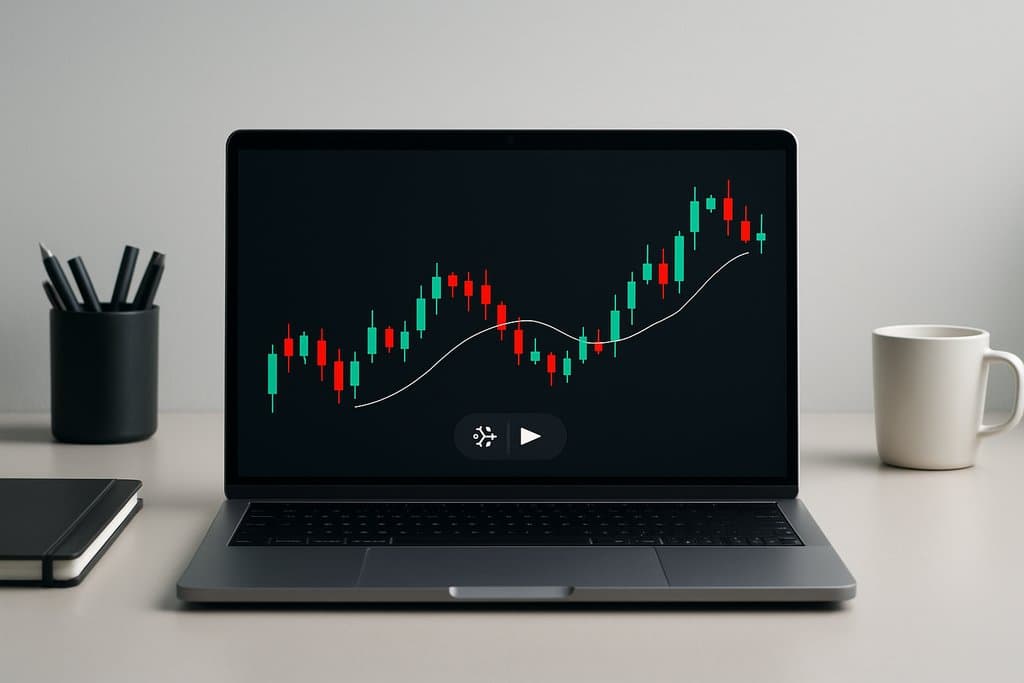
Manual trading hits a ceiling fast. You miss setups overnight, hesitate when the chart moves, and execute inconsistently after a bad week. Trading automation removes the friction between your plan and the market — but only if you build it with the same discipline you'd give a production system, not a Saturday afternoon side project.
This guide walks through what actually makes automation work: the building blocks, the execution mechanics that matter, the validation that catches overfitting, and a deployment path that doesn't require you to write a line of code.
What trading automation really means
Trading automation is encoding your logic into a system that monitors data and executes actions without manual intervention. The spectrum runs from smart alerts → semi-automatic order placement → fully systematic engines managing positions, risk, and allocations.
The common ingredient is deterministic logic tied to data streams. You specify what to watch, how to decide, what to do — then let the system run. The system doesn't care about your mood. It cares about whether your rules fire.
This is broader than what most people mean by "algorithmic trading," which leans toward market making and HFT. Trading automation covers everything from a weekly DCA rule to a multi-asset macro overlay.
The building blocks of an automated trading system
Signals and data
Signal quality determines everything downstream. Inputs include:
- Price and volume — feeding indicators like RSI, MACD, ATR, Bollinger Bands, Supertrend
- News and events — Apple product announcements, tariff headlines, CPI prints
- Alternative data — social feeds, satellite imagery, weather events, on-chain flows
Latency and relevance matter. A fast but noisy signal harms performance more than a slower clean one.
Timeframes change behavior. A signal that works on 2h often behaves differently on 8h or daily because volatility and noise scale non-linearly. Add regime awareness — trend-following thrives in persistent moves and bleeds in chop; mean reversion does the opposite. Implement regime filters (volatility thresholds, ADX, MA slopes) that toggle strategies on or off, or shift parameters dynamically.
Execution mechanics
Once a condition triggers, execution quality is the next edge.
| Order type | Primary trade-off |
|---|---|
| Market | High fill certainty, higher slippage in volatility |
| Limit | Price control, risk of missed fills |
| Stop / Stop-limit | Breakout entries, gap and partial-fill risk |
| Post-only | Maker fees, slower fills |
Slippage — the difference between expected and executed price — is the primary source of decay between backtest and live. Your automation should account for spread, fees, and slippage by design. That means simulating realistic costs, using limit orders when appropriate, and throttling order placement during thin liquidity.
Build guardrails: kill switches for extreme moves, API rate limiting, idempotency to avoid duplicate orders, detailed logging for audits.
Backtesting and validation
Backtesting is your first line of defense against flawed logic. Five non-negotiables:
- Clean data, free of survivorship bias
- No lookahead — compute signals only with information available at the time
- Realistic execution — spreads, fees, latency, partial fills
- Out-of-sample testing — train / test split with no leakage
- Walk-forward validation — refit periodically on a recent window, step forward
Backtesting is not about maximizing the backtest Sharpe. It is about understanding distributional risk so you can operate with confidence.
Position sizing is the forgotten lever. The same logic looks very different with volatility-scaled sizing, fixed fractional risk, or Kelly-derived sizing. Use Monte Carlo on trade sequences to see sensitivity to streaks of wins and losses.
Safe operations
Treat your automated trading like a production system. Monitor data feeds, broker connections, and strategy heartbeats. Alert on missing data, order rejections, and variance between expected and realized fills. Version strategies and maintain a changelog so you can attribute performance shifts to market regimes or code changes.
Paper trade first. Then live with small size and progressive exposure. Combine risk limits at order, strategy, and portfolio levels. Daily stop-outs and circuit breakers prevent runaway losses when markets gap or spreads blow out.
Why conversational automation accelerates everything
A modern platform compresses the friction between idea and live execution. Obside does this by accepting plain English, compiling it to executable strategies, and routing orders through your connected brokers and exchanges. The result: idea → working bot in minutes.
Say Alert me when BTC rises above a threshold and daily volume doubles and Obside watches both conditions. Say Buy $1,000 of BTC if price is below $100,000 and it places the order when the rule fires. Specify a full strategy — Buy on bullish RSI divergence on 15m, stop at the day's low, take profit at 10% — and the engine backtests it instantly, then runs it live when you're satisfied.
Obside won the Innovation Prize at the 2024 Paris Trading Expo and is supported by Microsoft for Startups.
Practical automations you can build today
Start with clear, measurable conditions and clear actions.
Alerts.
Notify me when RSI crosses 70 and MACD turns bearish on EUR/USD 1h.
Catch momentum exhaustion without committing capital.
Conditional actions.
Buy $1,000 of BTC if price is below $100,000, with immediate stop and take-profit attached.
Removes friction between decision and execution.
Full strategies.
Buy on bullish RSI divergence on 15m, stop at the day's low, take profit at 10%, trail risk as price moves.
The full loop in one sentence.
Event triggers.
Buy a small amount of Tesla when Elon Musk tweets about it and premarket volume is above 20-day average. Sell my stock basket if new tariffs are announced.
Portfolio rules.
Keep 50% in BTC, 25% in ETH, 25% in USDC. Rebalance when drift exceeds 5%. Buy $50 of BTC every Monday at 10:00 AM.
Multi-timeframe logic.
Enter when Supertrend is bullish on 2h and 8h, provided RSI is not overbought. Exit on 2h Supertrend flip with a 5 ATR (2h) trailing stop.
Launch your first automated strategy in 7 steps
Step 1: Describe the idea to Copilot
Be explicit about conditions, timeframes, and actions:
Buy when RSI shows a bullish divergence on 15m. Stop at today's low. Take profit at 10%.
Step 2: Inspect the generated logic
Copilot translates your description into structured rules. Check indicators, thresholds, and order types. Add constraints — Trade only during liquid hours or Skip trades around major economic releases.
Step 3: Backtest in seconds
Obside runs your strategy historically and shows win rate, profit factor, drawdown, exposure. Review trade lists to spot unrealistic fills or edge cases.
Step 4: Refine safely
Adjust parameters and rerun. Introduce slippage and fee assumptions matched to your broker. Consider walk-forward validation for parameter stability.
Step 5: Connect your broker
Link your account so Obside can route orders. Keep size small at first; enable alerts on every action to retain oversight.
Step 6: Go live with safeguards
Daily loss limits. Max concurrent positions. Account-level kill switch. Monitoring that alerts if data feeds fail or orders get rejected.
Step 7: Review and iterate
After a week, analyze logs and fills. Compare live to backtest and paper. One improvement at a time.
Benefits and the trade-offs
Speed and persistence first. An automated system never sleeps or hesitates. Consistency follows — strategy executes the same way every time, removing emotional deviation. Scale rounds it out: monitor hundreds of instruments and events in parallel, surfacing only the moments matching your plan.
The trade-offs:
- Overfitting hides fragility. Beautiful backtests fail live. Validate out-of-sample.
- Regime shifts break edges. Build regime filters or accept underperformance windows.
- Operational risks. APIs fail, venues go offline, data lags. Build retries and idempotency.
- Costs erase thin edges. Simulate fees and slippage realistically; bias toward simplicity.
What's next
Pick one rule you trust. Describe it to Obside Copilot in one sentence. Backtest with realistic costs. Paper trade for two weeks. Go live with small size and a daily loss cap.
Trading automation isn't about removing the trader. It's about removing friction, delay, and inconsistency so your edge can compound. With Obside, the gap between idea and live execution is minutes, not weeks.
Educational content only. This is not investment advice. Trading involves risk, including possible loss of capital.
FAQ
No. Traditional algorithmic trading often required programming, but modern platforms compile plain-English rules into executable strategies. Coding helps for proprietary data or unusual logic. For most retail and prosumer use cases, no-code now covers multi-timeframe, news-driven, and portfolio-level strategies.
Related articles
- Trading Bot Guide: Automate Strategy from Idea to Execution
- Automated Trading: What It Is, How It Works, and How to Start
- Automated Trading Bots: Build, Test, and Deploy Fast
- Algorithmic Trading: Build, Test, and Automate
- Algorithmic Trading Platform: Choose, Build, Automate
- Free Trading Bot: How to Automate Trades at $0
Try Obside on your portfolio
Connect your broker and automate your strategy with a prompt.
Get started