
Automated Trading: How It Works and How to Start
Markets move too fast for manual execution, and emotions ruin otherwise solid plans. If you have missed an entry because you stepped away, chased a trade after a spike, or failed to cut a loss, you already know the problem automated trading solves. You want a system that listens to your rules and acts instantly and consistently. That is the promise. This guide shows you exactly how to deliver on it.
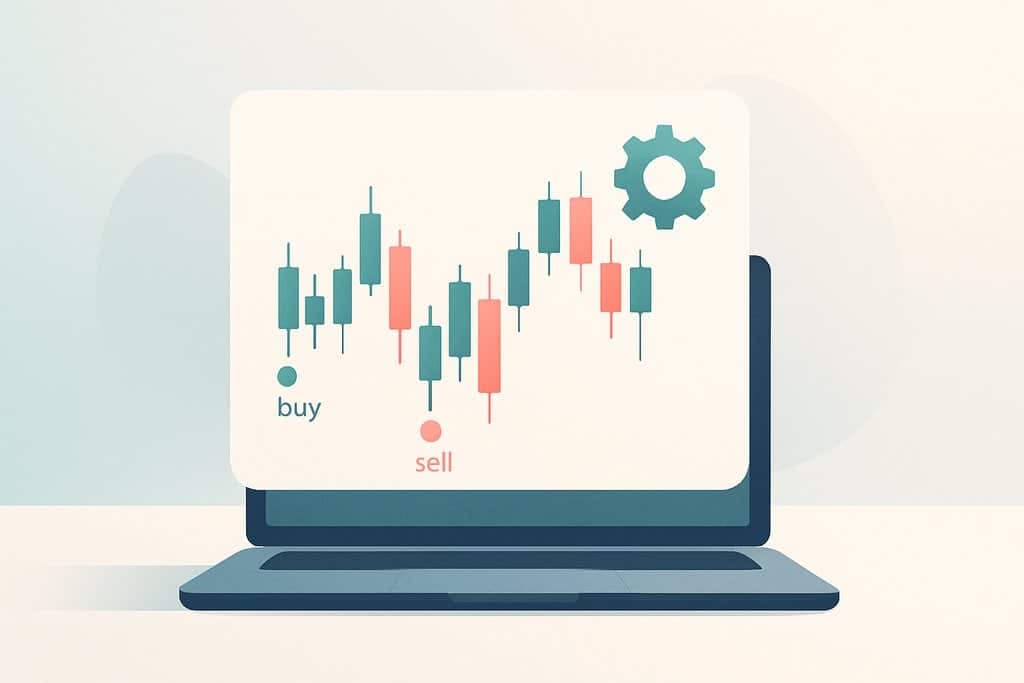
Markets move too fast for manual execution, and emotions ruin otherwise solid plans. If you have missed an entry because you stepped away, chased a trade after a spike, or failed to cut a loss, you already know the problem automated trading solves. You want a system that listens to your rules and acts instantly and consistently. That is the promise. This guide shows you exactly how to deliver on it.
What automated trading is
Automated trading is the use of predefined rules and software to place and manage trades without manual intervention. You design the logic that generates signals and manages risk. A system then executes orders on your behalf when market conditions match those rules. In practice this ranges from a simple alert prompting a manual click to a fully automated strategy that opens, manages, and closes positions across multiple markets.
Two terms overlap: automated trading and algorithmic trading. Most practitioners use them interchangeably. Some emphasize the quantitative signal-generation process as "algorithmic" and the hands-free execution as "automated." For a concise overview, see Investopedia's algorithmic trading definition.
Automated trading systems include four building blocks:
| Block | What it does |
|---|---|
| Data | Prices, volumes, fundamentals, news, macro events |
| Signal logic | Rules that decide what to buy or sell and when |
| Execution | Translates signals into orders — type, size, routing |
| Risk control | Stops, position sizing, daily loss limits |
When these blocks work together, you get an always-on process that screens markets and acts the moment conditions match.
Why traders adopt automated trading
The appeal has grown across retail and professional segments because markets are information-dense and time-constrained. Crypto trades 24/7. Traditional assets react within seconds to earnings, economic prints, and breaking news. Humans do not scale across multiple watchlists or time zones.
- Speed of execution that stays consistent at any hour
- Emotional discipline that enforces rules without bias
- Simultaneous monitoring across prices, indicators, and news
Speed is not only latency — it is consistency. The same rule executes the same way at 03:00 as at 15:00. Discipline follows from that consistency. When a stop triggers, the system exits. When a signal is missing one condition, no trade is placed. Automation lets you monitor hundreds of instruments and several types of information at once.
Inside the system: signals, execution, feedback
Signals
A signal is a rule. "Buy when the 50-period MA crosses above the 200-period MA and RSI(14) is below 70." "Sell when a headline mentions new tariffs on a sector you hold." Precision is everything. If the signal is ambiguous, the system cannot decide.
Execution
Execution is more than pressing buy or sell. Define order types, slippage assumptions, fail-safes. Market orders fill quickly but suffer in volatile conditions. Limit orders improve price control but can miss fills. Many traders blend the two — limit orders with a small offset and a timeout that converts to market after a short delay. Trailing stops, profit targets, and partial take-profits encoded upfront, not adjusted on the fly.
Feedback
Feedback closes the loop. Your system logs every decision, tracks realized costs (commissions and slippage), feeds that back into research. If a signal works on paper but fails in live execution, adapt either the execution layer or the signal logic. This cycle of design-test-deploy-refine separates hobbyist bots from robust automation.
Platforms now make this cycle accessible without code. Obside is a financial automation SaaS that turns plain-language instructions into market actions. Instead of writing scripts, you describe what you want in chat, and Obside Copilot generates alerts, places orders, or manages portfolios. For broader AI-driven workflows, see our AI trading guide.
Prompts that work out of the box:
Alert me if Bitcoin rises above $150,000 and daily volume doubles
Buy $1,000 of Bitcoin if the price is below $100,000
Notify me if RSI crosses 70 on EUR/USD and MACD turns bearish
Multi-condition strategies with indicators and timeframes can be backtested in seconds with Obside's engine.
Translate ideas into precise, testable rules before you automate. Ambiguity creates inconsistent results.
Signal design that survives the real world
The hardest part is not automating a rule. It is designing a rule that holds up outside the backtest. Three principles help.
Information should be timely and robust
Indicators like MAs and RSI are common because they are simple and reflect price behavior many participants watch. Event-driven signals can be powerful if the events are clear and the source is reliable. "If Apple announces a new product" can be useful when paired with execution logic that accounts for the volatility burst.
Balance sensitivity and selectivity
A rule that triggers constantly racks up transaction costs and noise trades. A rule that triggers rarely is not actionable. Tune through parameters — lookback windows, thresholds, filters that exclude low-volume or high-volatility periods.
Testable and reproducible
If you cannot test it, you cannot trust it. Fast backtesting matters. With Obside: describe a strategy like "Buy on bullish RSI divergence on the 15-minute chart, stop at the day's low, take profit at 10%." Obside simulates on historical data in seconds. Adjust thresholds and see how equity curve, drawdowns, and win rate change, then lock the parameters. For deeper principles, see Trading Strategy: Build, Test, and Automate Rules That Last.
Execution quality, slippage, and costs
A profitable-looking strategy can struggle in production if execution is sloppy. Slippage is the difference between intended and actual fill — it comes from spread width, order-book depth, or routing delays.
Match order type to conditions:
- Liquid large-caps, regular hours. Limit orders near bid/ask reduce slippage without hurting fills
- Thin altcoins or news spikes. Smart marketable limit with a small offset captures momentum while capping deviation
Transaction costs matter too. Commissions, exchange fees, and financing erode edge, especially in higher-frequency systems. Always include realistic costs in backtests.
Survivorship and look-ahead bias inflate results. Survivorship bias omits delisted or failed assets. Look-ahead bias uses information that was not available at the time. Both are mitigated by careful dataset selection and platform safeguards.
Latency between signal trigger and order placement matters when external data — news or macro prints — drives the signal. Obside ingests market data, technical indicators, and even news or macro data, then triggers actions in real time. Encode rules like "Sell stocks if new tariffs are announced" or "Buy oil when a hurricane hits" without writing integration code.
Backtests that ignore costs, slippage, or data issues mislead. Validate assumptions and stress test execution.
Risk management for automated systems
Risk management is where automated trading often shines compared to manual execution. Because rules are explicit, you can enforce limits mechanically.
Position sizing scales trades to your risk per setup. Fixed fractional (1% of account equity per trade) or volatility-adjusted (use ATR to scale positions smaller in choppy markets).
Stops belong where your thesis is invalidated, not where the loss feels comfortable. Trailing stops protect gains while letting winners run.
Portfolio-level controls cap total exposure to a sector or factor. If daily drawdown exceeds a threshold, pause trading. Simple rules that reduce the chance a single outage or regime shift inflicts a crippling loss.
Regime detection is one practical method. Many strategies perform differently in trending versus ranging markets. Use a higher-timeframe filter — Supertrend on the 8-hour chart — to gate entries on a lower timeframe. If aligned, take signals. If not, wait. In Obside, encode this logic in plain language and add a 5x ATR trailing stop on the 2-hour chart. When the Supertrend flips, the position closes automatically.
A practical workflow: idea to automation in days
First, express the idea clearly. Write one paragraph stating market, timeframe, signal, risk, and exit. Example: "Buy $50 of Bitcoin every Monday at 10:00 AM. Add a 20% catastrophic stop. Otherwise never sell." That is DCA, easy to automate.
Second, test the logic. Use a backtester with fees, slippage, and realistic data. Tweak parameters to see if results are stable. If a strategy collapses when you shift a parameter 10%, suspect overfitting.
Third, paper trade. Run the strategy in simulation against live data. Confirm signals, fills, and logs match expectations. The paper trading guide covers a clean workflow.
Fourth, go live with small size. Monitor performance and execution metrics. Expand gradually as confidence grows.
Obside compresses these steps. Use Obside Copilot to describe logic in natural language: "Notify me if RSI crosses 70 on EUR/USD and MACD turns bearish." Click to convert that alert into an automated action: "Sell a portion of my EUR/USD position." Make event-driven rules: "Alert me if Apple announces a new product" or "Tell me when OpenAI announces a new AI model." When ready, connect your broker or exchange, backtest the full strategy in seconds, switch from alerts to automated execution. For builder details, see AI Trading Bot: From Idea to Live Strategy.
Three concrete automated trading examples
Momentum on crypto. Buy when price closes above the 20-period high on a 2-hour chart, RSI(14) below 70, 8-hour Supertrend bullish. Stop at 5x ATR. Trailing take-profit. In Obside: "When the 2-hour Supertrend turns bullish, RSI is not overbought, and the 8-hour Supertrend agrees, buy. Reverse for selling. Add a trailing stop." Backtest on several coins. Analyze drawdowns. Deploy on a small allocation.
Event-driven for equities. Hedge if the S&P 500 drops 10% from recent high. Encode: "Sell all positions if the S&P 500 drops 10%." Add a news trigger: "Sell semiconductor ETF if new tariffs are announced." Obside listens to both price and news.
Portfolio automation. Maintain 50% BTC, 25% ETH, 25% USDC. Rebalance monthly or when deviations exceed a threshold. If volatility spikes, lower risk temporarily or add a stop on the crypto sleeve. Automation handles discipline. Rebalancing happens even when you are away.
Benefits and considerations
Benefits are clear. Automation removes hesitation and enforces rules. It scales your attention across markets and timeframes. It runs 24/7 — crucial for crypto and global event response. With Obside, you go from idea to backtest to live deployment in minutes, combining price, technical, and event triggers without writing code.
Considerations to respect:
- Data quality is critical. Bad data yields bad signals.
- Overfitting is the most common mistake. Use out-of-sample testing, cross-validation, keep parameter counts modest.
- Market regimes change. A trend strategy struggles in a range. Add filters or diversify across strategies.
- Technical failures. Include kill switches, max daily loss limits, alerts that notify you if something goes off script.
To broaden your toolkit, explore Quantitative Trading: Build, Test, and Automate.
Start automating today
If you are new to automated trading, start small and build confidence. Write down one rule you already trade manually. Translate it into clear conditions, a stop, and an exit. Backtest with realistic costs. Paper trade for a week. Automate with minimal size. This cycle compounds your learning quickly.
For a no-code path, create a free Obside account. Describe your rule in Obside Copilot, run a fast backtest, and deploy it with your broker or exchange connection. You can also explore the marketplace where traders share strategies — or keep it private and customize for your needs.
Educational content only. This is not investment advice. Trading involves risk, including possible loss of capital.
FAQ
Often used interchangeably. Algorithmic trading emphasizes the quantitative process that creates signals. Automated trading emphasizes the hands-free execution of those signals. Most modern systems do both, from signal generation to risk and execution.
Related articles
- How to Invest: A Practical Guide to Start and Succeed
- Forex Trading Guide: How the Currency Market Works
- Trading in 2025: Strategies, Tools & Day Trading Guide
- AI Stocks: How to Invest in the AI Boom
- Best Stocks to Buy Now: A Practical Investor Guide
- Algorithmic Trading: Build, Test & Automate in 2026
Try Obside on your portfolio
Connect your broker and automate your strategy with a prompt.
Get started