
Paper Trading: How to Use It Without Fooling Yourself
Paper trading sounds harmless. You test ideas, build muscle memory, and learn the platform — all without risking capital. But most paper accounts lie to you in three ways: fills are too generous, slippage is invisible, and emotions are absent. Traders who go live after months of "profitable" paper trading often blow up in their first 30 sessions.
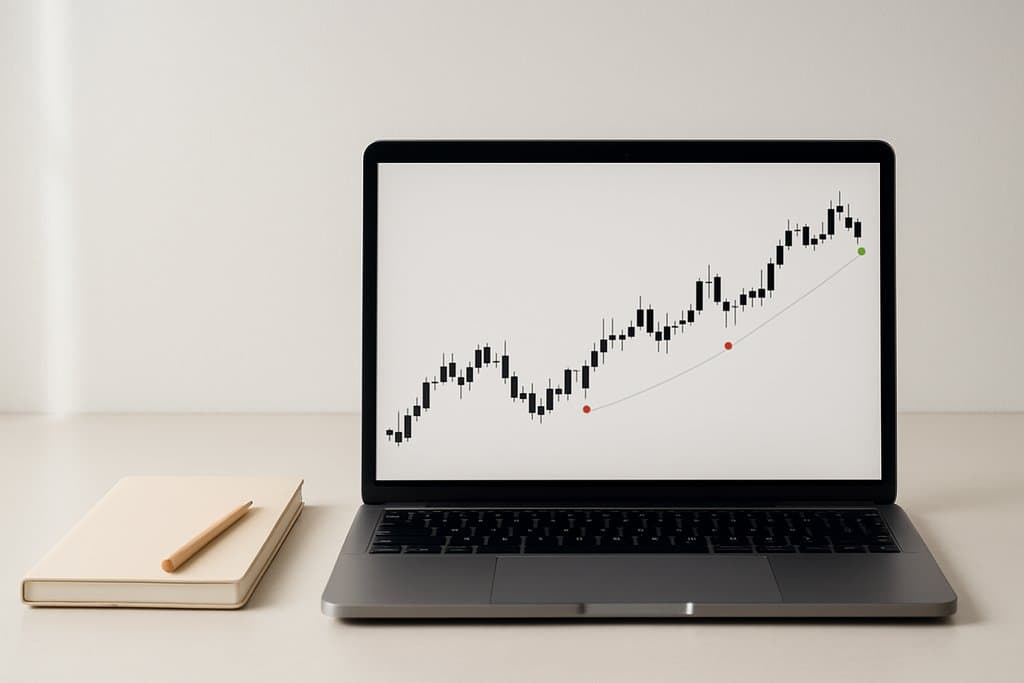
Paper trading sounds harmless. You test ideas, build muscle memory, and learn the platform — all without risking capital. But most paper accounts lie to you in three ways: fills are too generous, slippage is invisible, and emotions are absent. Traders who go live after months of "profitable" paper trading often blow up in their first 30 sessions.
This guide shows you how to paper trade so the results actually transfer to live execution. The fixes are simple, the discipline isn't.
What paper trading actually is
Paper trading is forward-testing in real markets with simulated capital. You place buy and sell orders, the platform models the fill, and your virtual P&L tracks the trade. Done right, it validates your strategy under live conditions: real spreads, real news, real noise. Done wrong, it tells you a story you want to hear.
Paper trading is not a backtest. Backtests run rules over historical data in seconds and answer "did this work?" Paper trading runs your rules forward in real time and answers "can I execute this consistently when the bar isn't yet closed?" Both belong in your workflow. Neither substitutes for the other.
How paper accounts get fills wrong (and how to fix it)
Most paper trading platforms default to optimistic fills. Limit orders fill the moment price touches them. Market orders fill at the bid or ask. Slippage is zero. Borrow costs and funding rates don't exist.
In live markets, none of that is true. Three settings make paper accounts honest:
| Setting | Default (optimistic) | Realistic value |
|---|---|---|
| Slippage on market orders | 0 | 0.05%–0.10% for liquid, 0.25%+ for thin |
| Limit fill rule | Touch | Through, with delay |
| Commission | 0 | Match your broker's actual schedule |
| Partial fill simulation | Off | On for illiquid instruments |
If your platform won't let you configure these, add the cost manually. Subtract 0.1% per round-trip from every win. Subtract more for crypto on weekends or thin small-caps.
The metrics that matter in a paper account
Win rate is the worst metric to optimize. A 90% win rate can lose money; a 35% win rate can compound aggressively. Focus on:
- Expectancy per trade — average outcome after costs. Must be positive.
- Profit factor — gross profit ÷ gross loss. Above 1.3 is workable.
- Max drawdown — peak-to-trough drop. Honest answer to "can I tolerate this?"
- Distribution of wins — if one outlier carries the curve, the system is fragile.
- Sample size — aim for 100+ trades or several market regimes, whichever comes first.
Sharpe and Sortino ratios are useful as risk-adjusted summaries but secondary to the four above.
How long to paper trade before going live
Three conditions, not three weeks:
- 30+ trades minimum. Below that, results are statistical noise.
- Multiple regimes covered. Trade through a high-volatility week, a quiet week, and at least one news catalyst.
- Execution feels mechanical. You take every signal that matches your rules, with no skipped trades and no extra ones.
A common mistake is paper-trading for six months in calm markets, then going live the week VIX hits 30. The strategy hasn't been stressed. Force the stress by running through known volatile windows in market replay when your live calendar is quiet.
The psychological gap paper trading can't close
Paper trading rehearses your rules. Live trading reveals your character.
A flawless paper run does not predict a flawless live run. The reason isn't strategy — it's the asymmetric weight of real money. Losing $100 of real capital activates loss aversion in a way a virtual $100 doesn't. Many paper-profitable traders fold the first time live drawdown hits a number they didn't expect.
Three habits help bridge the gap:
- Trade live in the smallest possible size for the first 30 trades. Crypto fractional, fractional shares, micro forex lots. The goal is to feel real P&L, not to make money.
- Pre-commit to a daily loss limit. Write it down. Stop trading the moment you hit it.
- Journal emotional state alongside every trade. Anxious? Overconfident? Bored? Patterns emerge fast.
A practical paper-to-live workflow
- Backtest the strategy on 12+ months of data, including a stress period.
- Paper trade with realistic costs for 30+ trades.
- Compare paper metrics to backtest expectations. Drift > 20% means investigate before scaling.
- Go live at minimum size for another 30 trades.
- Scale only if live metrics match paper within reasonable tolerance.
Most blowups skip step 3 or step 4. They're the cheapest insurance you'll buy.
What to paper trade first
Three strategy families are well-suited to a paper account because their rules are unambiguous:
- Trend pullbacks — wait for an established trend, enter on a pullback to a moving average, exit on trend break. Slow enough to execute without panic, structured enough to test.
- RSI mean reversion — RSI(2) extremes on liquid index ETFs. High frequency, high win rate. See RSI indicator guide for tuning.
- Range breakouts — clean consolidation, breakout on volume, stop inside the range. Easy to define, easy to validate.
Avoid paper-trading discretionary chart patterns until you've systematized the entry criteria. "Looks like a wedge" is not a backtest-ready rule.
Where Obside fits in the paper workflow
Obside paper mode runs the same rule engine as live execution. That continuity is the point: when you flip from paper to live, the logic is identical — no manual re-implementation, no translation errors.
Describe your strategy in plain English to Obside Copilot:
"Buy SPY when RSI(2) drops below 5 and recovers above 10. Stop at 1.5×ATR below entry. Exit when RSI(2) > 60 or after 3 sessions. Risk 0.5% per trade."
Copilot translates that, backtests it in seconds against historical data, runs it in paper against live feeds, and — when you're ready — connects to your broker for live execution. Same rules, same risk caps, same alerts.
Create a free Obside account to paper trade your strategy with realistic costs, smart alerts, and a one-click switch to live execution when the metrics hold.
Educational content only. This is not investment advice. Trading involves risk, including possible loss of capital.
FAQ
Paper trading is worth it for rule validation, execution practice, and platform familiarity. But after 30 paper trades that match your rules, the marginal value drops sharply. The remaining lessons — handling real drawdowns, sizing decisions under stress — only happen with live capital.
Related articles
- Trading Simulator: Practice, Test, and Improve Strategy
- Trading Strategy: Build, Test, and Automate Rules That Last
- Day Trading Strategies: Proven Setups and Risk Rules
- Backtesting Software: How to Pick, Use, and Trust It
- Trading Automation: From Idea to Real-Time Execution
- Trading for Beginners: Simple Steps to Your First Trades
Try Obside on your portfolio
Connect your broker and automate your strategy with a prompt.
Get started