
Trading Strategy: Build Rules That Survive Live Markets
A trading strategy that lives on a chart screenshot is a trading idea. A strategy that compounds over years is a rule set you can describe in one page, test against history, automate without ambiguity, and run when you're tired, distracted, or wrong about the market.
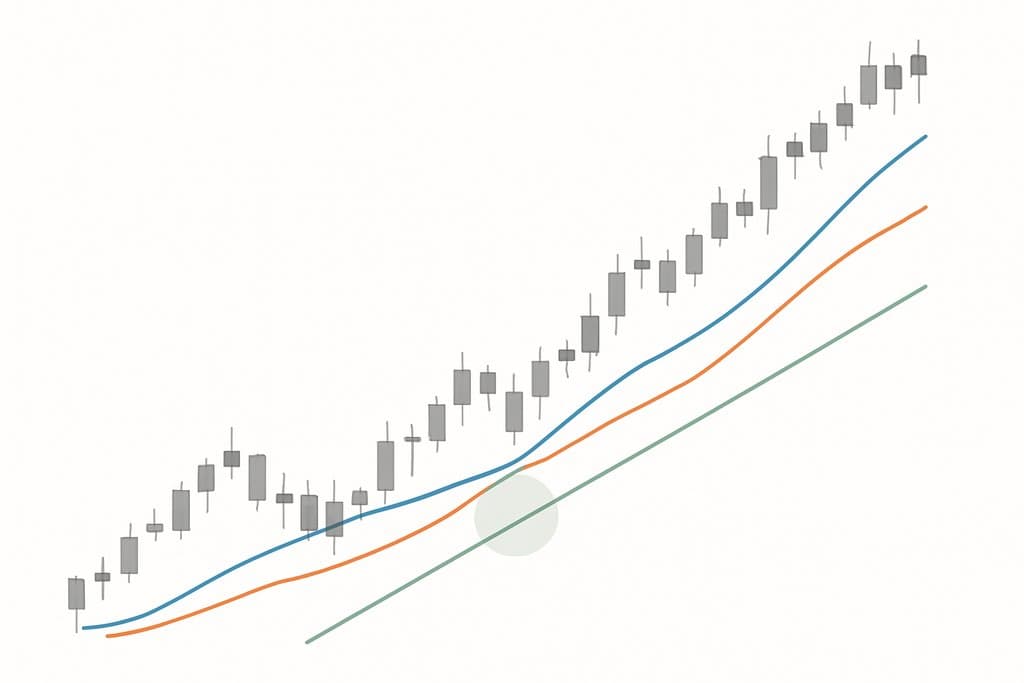
A trading strategy that lives on a chart screenshot is a trading idea. A strategy that compounds over years is a rule set you can describe in one page, test against history, automate without ambiguity, and run when you're tired, distracted, or wrong about the market.
This guide gives you the structure. By the end, you can write a strategy that's testable, executable, and resilient — not another set of vague heuristics dressed up as a system.
What a trading strategy actually is
A trading strategy is a complete specification of how capital moves through markets. At minimum it answers seven questions:
- What do I trade?
- On what timeframe?
- What conditions open a position?
- Where does the position close in a loss?
- Where does it close in a win (or how does it trail)?
- How big is each position?
- When do I not trade?
Anything that skips one of these is incomplete. The most common gap is question 7 — the regime filter — and it's why strategies that worked in 2024 trends fall apart in 2025 chop.
Why a rule set beats discretion
Discretionary trading isn't wrong, it's hard. Even pros with decades of screen time benefit from systematizing the repeatable parts. A rule-based core gives you four advantages:
- Testable: you can run it against 10 years of data and see whether the edge exists
- Repeatable: two traders running the same rules produce comparable results
- Automatable: machines execute rules without hesitation, fear, or fatigue
- Improvable: when you tweak a variable, you can attribute the impact
Discretion is most powerful when it intervenes against rules that have already been proven to work — not when it substitutes for the rules.
The seven core components
1. Market and timeframe
Pick one instrument and one timeframe to start. Cross-instrument edges exist, but they require infrastructure most retail traders don't have. EUR/USD on the 1-hour, SPY on the daily, or BTC on the 4-hour each have well-documented behavior. Begin with a market you can monitor consistently.
2. Entry criteria
Be explicit. "When trend is strong" is not a rule. "When 50 EMA > 200 EMA on the daily AND price closes above the prior swing high AND RSI(14) > 50" is a rule. Three to five conditions max — more and you'll overfit.
3. Stop loss
The stop defines where your hypothesis is wrong. Two common methods:
- Structural: just beyond the last meaningful pivot (swing low for longs)
- Volatility-based: 1.5–2× ATR below entry, adapts to current conditions
Avoid arbitrary round-number stops. They cluster, and markets sweep them.
4. Profit-taking
The hardest layer. Three approaches handle most cases:
| Method | When to use |
|---|---|
| Fixed R-multiple (e.g., +2R) | Mean reversion, range trading |
| Trailing stop (chandelier, 3×ATR) | Trend following |
| Partial scale-out | Hybrid; lock some, ride some |
The "best" exit is the one whose payoff distribution matches your edge.
5. Position sizing
Risk a fixed fraction of equity per trade — 0.25%–1% for most strategies. Convert to share count via: position_size = (account_equity × risk_per_trade%) / stop_distance. This keeps the dollar loss constant across trades regardless of volatility.
6. Trade management
What happens between entry and exit? Do you move stops? Add to winners? Cut on time? Define it in advance. Discretionary management is where edge usually leaks.
7. Regime filter (what you skip)
The most underrated component. Examples:
- Don't take mean reversion trades when VIX > 25
- Skip breakouts in the last hour of the session
- No new entries within 24 hours of FOMC, NFP, or CPI prints
- No counter-trend setups when the daily ADX > 30
The goal is to avoid the conditions where your edge inverts. This single layer can lift a marginal strategy into a real one.
Four strategy families that have stood the test of time
Trend following
Ride sustained directional moves. Entries on breakouts or moving-average crossovers. Win rates typically 30–45%, but average win ≫ average loss. Drawdowns are long; psychological tolerance is the gating factor.
Mean reversion
Fade short-term extremes back to an average. Win rates 60–75%, but average win < average loss. Works in range-bound conditions, blows up in regime shifts. The Larry Connors RSI(2) approach is a clean entry point.
Breakout and momentum
Trade volatility expansion from compression. Volume confirmation matters. False breakouts are common, so a stop inside the range or an ATR-based stop is essential.
Event-driven
Earnings, macro releases, news catalysts. Edges exist but are crowded. Combining a catalyst with a technical filter ("buy on earnings beat AND the gap up holds the open price") narrows the noise.
Pick one. Master it. Add a second only when the first has 100+ live trades in the book.
A working example: build a strategy step by step
You want to systematize a swing trade idea on Bitcoin. Here's the seven-component buildout:
- Market & timeframe: BTC/USDT, 4-hour chart.
- Entry: Close above the 20 EMA and RSI(14) > 50 and the 4h trend filter (20 EMA > 50 EMA) was bullish at the prior bar.
- Stop: 1.5×ATR(14) below entry.
- Profit-taking: TP1 at +1R (close 50%), trail remainder with 3×ATR.
- Position sizing: 0.5% account risk per trade.
- Trade management: stop to breakeven after TP1. No new positions while one is open.
- Regime filter: skip if BTC realized 7-day volatility is in the top decile (overreaction days).
That's a complete, testable strategy. The rule set fits on a sticky note.
Backtesting without lying to yourself
Backtesting tells you whether the rules had an edge in history. It does not tell you whether they'll work in 2026. Three habits keep backtests honest:
- Out-of-sample data — develop on 2019–2023, test on 2024–2025. Don't touch the test data during tuning.
- Walk-forward validation — re-fit parameters periodically and test on the next window. Smooths overfitting.
- Realistic costs — spread, commission, slippage. The numbers vary by broker and asset; ask, don't guess.
If your strategy needs ten parameters to look good in backtest, it's overfit. Robust strategies have 3–5 parameters and tolerate ±20% changes to each without collapsing.
Where Obside compresses the workflow
The traditional rule-builder workflow takes weeks: code the strategy, fight the backtest engine, debug execution, monitor manually. Obside collapses it.
Describe the BTC strategy above to Obside Copilot in plain English:
"On BTC/USDT 4h: buy when close > 20 EMA, RSI(14) > 50, and the 20 EMA was above the 50 EMA at the prior bar. Stop at 1.5×ATR. Take 50% at +1R, trail rest with 3×ATR. Risk 0.5%. Skip when 7-day realized vol is in the top 10%."
Copilot translates that into a rule, runs an instant backtest, and — when you approve — fires alerts or executes via your connected broker. The same rules run in paper mode first; one click flips to live. No code, no glue scripts.
Create a free Obside account to write your trading strategy in plain English, backtest in seconds, paper trade it, and automate live execution through your existing broker.
Educational content only. This is not investment advice. Trading involves risk, including possible loss of capital.
FAQ
As simple as possible. A two-rule system (one entry, one exit) that you can execute mechanically is more valuable than a ten-rule system you abandon after three losses. Most pro strategies have 3–5 rules total.
Related articles
- Types of Trading: Strategies, Styles, and Examples
- Buy and Sell Trading: A Practical, Proven Guide to Rules
- Day Trading Strategies: Proven Setups and Risk Rules
- Paper Trading: Complete Guide to Practice Strategies
- Technical Analysis: Read Markets Like a Pro
- Backtesting Software: How to Pick, Use, and Trust It
Try Obside on your portfolio
Connect your broker and automate your strategy with a prompt.
Get started