
Types of Trading: Find the Style That Fits Your Life
The wrong trading style isn't merely unprofitable — it's exhausting. A day trader who can only check screens at lunch fights against the market and against their own life. A position trader chasing intraday noise will outwork their edge.
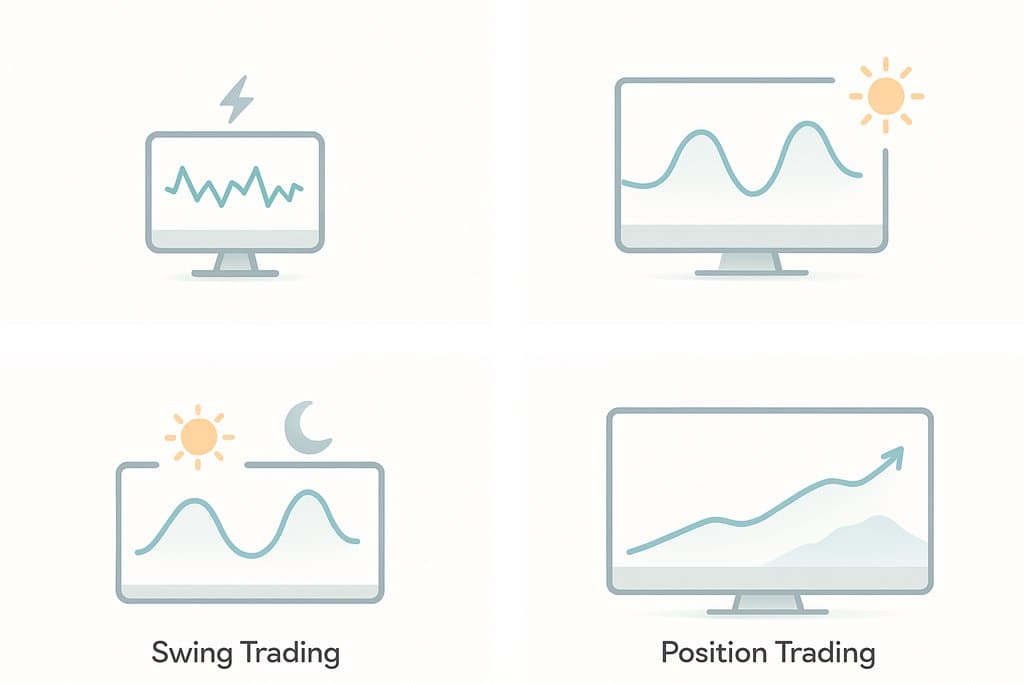
The wrong trading style isn't merely unprofitable — it's exhausting. A day trader who can only check screens at lunch fights against the market and against their own life. A position trader chasing intraday noise will outwork their edge.
Picking the right style isn't about which style "wins." It's about which style matches your time, your temperament, and the catalysts you actually understand. This guide maps the landscape so you can decide before you put on size.
The three dimensions of every trading style
Most "types of trading" lists conflate three independent axes. Separating them makes the choice clearer.
| Dimension | Question it answers | Examples |
|---|---|---|
| Time horizon | How long do you hold? | Scalping, day, swing, position |
| Decision style | How are decisions made? | Discretionary, systematic, algorithmic |
| Catalyst / instrument | What drives the trade? | Technical, fundamental, event-driven |
You're always making choices on all three axes — even when you don't think about it. A "swing trader" is also choosing systematic vs discretionary and the catalyst that drives entries. Naming those choices explicitly lets you tune each one.
Types of trading by time horizon
Scalping (seconds to minutes)
Tiny edges captured many times per session. Requires deep liquidity, the lowest possible commissions, and microsecond-level reaction. Suits people who tolerate intense focus and accept that 80% of trades are small wins and losses around a thin average.
Day trading (minutes to hours)
Positions open and close within a single session. No overnight risk. The most popular retail style, also the most punishing — execution costs and slippage dominate, and PDT rules in the US require $25k minimum equity for active accounts. See day trading for beginners for the structured entry path.
Swing trading (days to weeks)
Hold through one or two sessions, exit on multi-day moves. Works well for people with day jobs. Daily or 4-hour charts reduce noise. Higher per-trade R:R compensates for fewer trades. Most empirically successful retail style for working professionals.
Position trading (weeks to months)
Capture major trends or thematic moves. Weekly charts, macro context, fundamental overlays. Few trades per year, but each can be material. Requires patience through long drawdowns.
| Style | Trades/month | Screen time | PDT risk | Avg R:R target |
|---|---|---|---|---|
| Scalping | 100–500+ | High | Yes (US) | 1:1 |
| Day trading | 20–80 | High | Yes (US) | 1:2 |
| Swing trading | 4–20 | Low–Medium | No | 1:3 |
| Position trading | 1–5 | Very low | No | 1:5+ |
If you can't reliably commit the screen time the style requires, the edge doesn't matter. Match style to life first.
Types of trading by decision style
Discretionary
Human-in-the-loop. You read context, weigh signals, make the call. Strengths: adapts to unusual conditions, leverages experience. Weaknesses: hard to measure, slow to improve, exposed to emotional decisions.
Systematic
Rules-defined, human-executed. You scan for setups manually but apply pre-specified entry and exit logic. The honest middle ground: testable but flexible.
Algorithmic
Rules-defined, machine-executed. Computer monitors conditions, fires orders, manages stops. Removes hesitation and missed signals. Required for high-frequency styles. Increasingly available without coding through platforms like Obside.
Most pros operate systematically inside a discretionary outer layer — rules govern entries and exits, judgment governs whether to be in the market at all.
Types of trading by catalyst
Trend following
Buy strength, sell weakness. Tools: moving averages, breakouts, Donchian channels, Supertrend. Wins big, loses small, drawdowns long. The longest-running edge in markets — decades of academic and practitioner evidence.
Mean reversion
Fade extremes. Tools: RSI, Bollinger Bands, z-scores. Wins often, loses rarely but large. Works in ranges, blows up in regime shifts. Pair with a trend filter to survive.
Breakout / momentum
Trade volatility expansion. Volume confirmation matters. False breakouts are common; an inside-the-range stop or ATR-based stop saves capital.
Statistical arbitrage / pairs
Long the cheap leg, short the expensive leg, bet on spread normalization. Capital-intensive, infrastructure-intensive. Best left to firms with the right pipes — most retail variants are too thin to survive after costs.
Event-driven
Earnings, macro releases, regulatory news, geopolitical surprises. Sharp moves, often slippage-heavy. Edges exist but are crowded — the alpha comes from combining a catalyst with a technical filter (e.g., "buy on earnings beat only if the gap holds the day's open").
Types of trading by instrument
The instrument constrains your tactics. Same strategy, different markets, different outcomes.
| Instrument | Hours | Volatility | Notable quirks |
|---|---|---|---|
| US large-cap equities | 9:30–16:00 ET | Moderate | Earnings gaps, halts, PDT rules |
| FX majors | 24/5 | Low–Moderate | Macro-driven, session overlaps matter |
| Crypto majors | 24/7 | High | Weekend liquidity gaps, funding rates |
| Index futures | 23/5 | Moderate | Roll dates, margin amplification |
| Options | Market hours | Variable | Greeks, expiry, complex P&L |
Your core rule set can stay constant across instruments. Stop multipliers, position sizing, and regime filters need to adapt. A 1.5×ATR stop on EUR/USD is not the same risk profile as 1.5×ATR on BTC/USDT.
How to pick your style
A four-question filter cuts through the noise:
- How many hours per day can I monitor markets? <1 hour → swing or position. 1–4 hours → swing or day. 4+ hours → any style fits.
- What's my tolerance for drawdown? <10% → mean reversion or position trading on uncorrelated assets. 20–30% → trend following or momentum. >30% → not for retail in any style.
- What catalysts do I actually understand? If you can't articulate what makes a stock move, don't trade single names. If you don't track macro, avoid FX. Trade what you can explain.
- Do I want a machine doing the clicks? If yes, lean systematic and pick a style that has clear rules. If no, lean discretionary and accept the time cost.
Combining multiple types of trading
After you've mastered one style, adding an uncorrelated second can smooth the equity curve. Common pairings:
- Trend following on FX + mean reversion on equity indices — different regimes, different drivers
- Long-only momentum on stocks + market-neutral pairs — reduces beta exposure
- Swing trading the core + occasional event-driven scalps — keeps the main strategy disciplined while capturing catalysts
The mistake is running three half-trained styles in parallel. You compound your mistakes, not your edges.
Where Obside fits across the types of trading
Obside is style-agnostic. Whether you trade a 5-minute breakout, a 4-hour pullback, or a quarterly rebalance, you describe it in plain English to Copilot and run the same rules in backtest, paper, and live execution.
A few real examples from the platform:
- "Buy SPY when RSI(2) drops below 5 and recovers above 10, exit after 3 sessions or RSI(2) > 60." (intraday mean reversion)
- "Long BTC when 4h Supertrend turns bullish and 8h Supertrend is also bullish, RSI < 70. Trail 5×ATR." (swing trend following)
- "Hold 50% BTC, 25% ETH, 25% USDC. Rebalance monthly or on 5% drift." (position-level allocation rule)
Create a free Obside account to test multiple trading styles in parallel, with instant backtests and a one-click switch from paper to live.
Educational content only. This is not investment advice. Trading involves risk, including possible loss of capital.
FAQ
Swing trading on liquid instruments — daily or 4-hour charts, large-cap stocks or major FX pairs. Slow enough that you can think before clicking, structured enough to learn from each trade. Day trading and scalping demand reflexes that take years to develop.
Related articles
- Trading Strategy: Build, Test, and Automate Rules That Last
- Day Trading Strategies: Proven Setups and Risk Rules
- Buy and Sell Trading: A Practical, Proven Guide to Rules
- Paper Trading: Complete Guide to Practice Strategies
- Trading for Beginners: Simple Steps to Your First Trades
- Technical Analysis: Read Markets Like a Pro
Try Obside on your portfolio
Connect your broker and automate your strategy with a prompt.
Get started