
Copy Trading Platforms: How to Choose and Succeed Safely
Copy trading sells a clean story: find a proven trader, mirror their account, profit while you sleep. The reality is messier. This guide covers how copy trading platforms actually work, the framework to evaluate them, the pitfalls that wipe out beginner copiers, and when it makes more sense to automate your own rules.
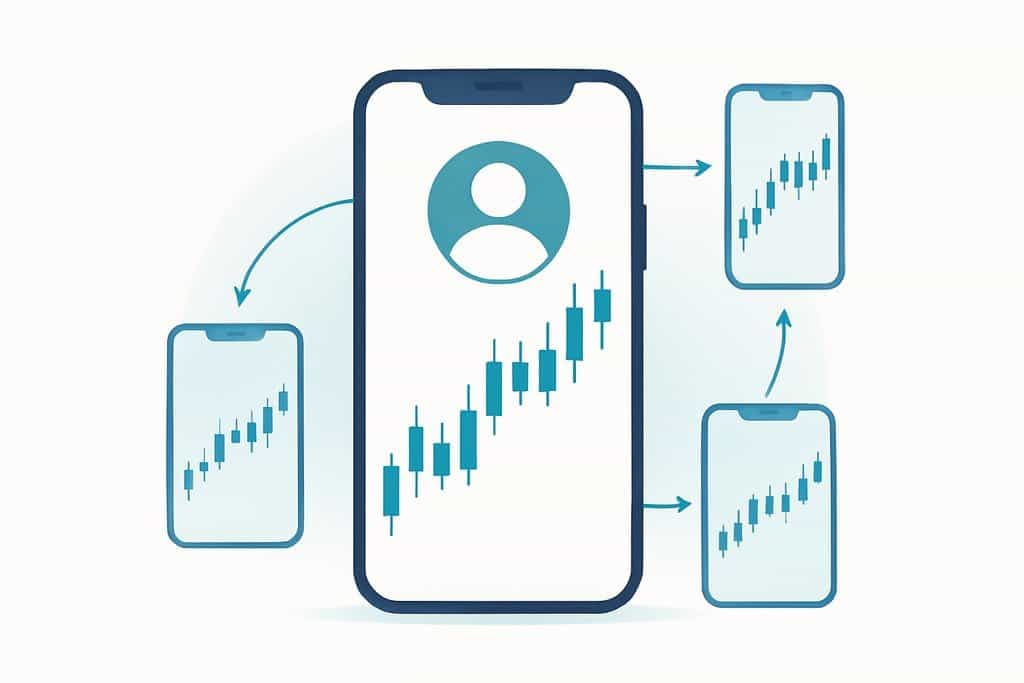
Copy trading sells a clean story: find a proven trader, mirror their account, profit while you sleep. The reality is messier. This guide covers how copy trading platforms actually work, the framework to evaluate them, the pitfalls that wipe out beginner copiers, and when it makes more sense to automate your own rules.
How copy trading platforms work
A copy trading platform connects strategy providers to followers. Providers trade on a master account or publish trades via API. The platform listens to every event and routes a corresponding order to each follower's account. Sounds simple. Five technical decisions decide whether the experience matches the marketing.
Sizing and allocation
The most common models:
- Fixed amount per trade. Same dollar per trade regardless of equity.
- Fixed fraction of equity. Position scales with your account size.
- Proportional copy. Your position size scales with the leader's relative risk.
- Equity-to-equity. If the leader allocates 2 percent of their capital, you allocate 2 percent.
Each has different risk implications. Equity-to-equity is generally cleanest but rarer.
Execution timing and latency
Even fast platforms have measurable latency between the leader's fill and yours. If a leader scalps for a few ticks, followers experience slippage in fast markets. The faster the leader's style, the more execution quality matters.
Instrument mapping
Leaders may trade specific symbols or derivatives that do not map cleanly to your broker. Robust platforms translate symbols and contract sizes correctly. Verify before funding — a mismatched ticker can cost more than the entire copy fee.
Risk controls
Look for: emergency stop copying, max drawdown guards, per-trade caps, ability to opt out of specific instruments, partial copy or late entry logic. Platforms that treat risk controls as an afterthought are dangerous.
Fees and revenue sharing
Three patterns: monthly subscription, performance fee with high water mark, spread markup. Some platforms combine them. Calculate the all-in cost per 100 trades in your instrument mix.
A framework for evaluating any platform
Use this every time. Three minutes per criterion. Move on if a platform fails any of them.
| Criterion | What to verify | Red flag |
|---|---|---|
| Track record length | 2+ years live, hundreds of trades | Six months of perfect performance |
| Strategy transparency | Instruments, holding time, logic family disclosed | "Proprietary AI" with no specifics |
| Execution reliability | Native broker integration, slippage data | No transparency on follower fills |
| Risk controls | Per-trade caps, equity stops, asset exclusions | Set-and-forget with no overrides |
| Capacity flags | Follower counts and AUM visible | Hidden crowding, top strategies closed |
| Fee mechanics | Clear schedule, including spread markups | Performance fee with weak high water mark |
| Community quality | Process-oriented discussion | Screenshots of profits, no losses |
A platform that fails on transparency cannot be trusted, regardless of returns. A platform with great transparency but poor execution cannot deliver, regardless of intent.
The honest cost structure
Headline returns lie about your net experience. Three drags often compound silently.
Subscription. Predictable but continues during drawdowns. The leader earns the fee whether you make money or not.
Performance fee. Aligns incentives but creates high water mark complexity. Some platforms reset water marks favorably for the leader after drawdowns.
Spread markups. The least visible cost. Particularly damaging for high-turnover strategies. A 0.5 pip markup on a strategy that takes 100 EUR/USD trades a month adds up fast.
Slippage. Leaders report fills from their own account. Followers may get worse prices. Platforms that publish average follower slippage by strategy give a fairer picture.
Risk of divergence
Even when you copy perfectly, your equity curve will subtly diverge from the leader's. Three reasons: execution timing, fees, allocation rounding. Goal is not zero divergence — it is controlled divergence that does not distort the risk profile.
Behavioral risk is the bigger killer. Most followers stop copying after a normal drawdown, then rejoin on new highs. That pattern destroys edge. Decide your risk budget and your sticking rules before you start. Write down the drawdown at which you will pause. Stick to it.
When to copy versus automate your own rules
Copy trading is a fine on-ramp. It is rarely the destination. Three signs you have outgrown it:
- You can articulate exactly why a leader's trades work.
- You want to add filters (volatility, news, regime) the leader does not use.
- You want diversification across more strategies than you can copy economically.
At that point, automation of your own rules makes more sense. A platform like Obside lets you describe the rules in plain English, validate with ultra-fast backtesting, and run live through your broker. Examples:
- "Buy when the 2h Supertrend turns bullish and RSI is below 70. Trail at 5 ATR. Exit on Supertrend flip."
- "Sell my stocks if new tariffs are announced that hit my holdings."
- "Alert me if Bitcoin breaks above 150,000 with daily volume doubling."
The advantages over pure copying: transparency you control, filters tuned to your tolerance, no per-strategy fees, no crowding risk, full backtest history.
A step-by-step setup that actually works
- Define objective and risk budget. Maximum drawdown you can hold through. Per-trade risk limit. Per-leader allocation cap.
- Shortlist platforms and brokers. Confirm support for your assets and broker. Test login, linking, and data refresh before funding.
- Two-pass filter on providers. First pass removes profiles with short history, poor disclosure, extreme leverage, or incoherent equity curves. Second pass compares risk-adjusted quality among finalists.
- Test small. Place a minimal allocation. Monitor fills during both calm and volatile sessions. Verify sizing, stops, and guardrails trigger correctly.
- Configure hard limits. Global equity stop. Concurrent position caps. Asset exclusions. News-window pauses if the platform supports them.
- Disciplined monitoring. Weekly review. Track slippage, divergence, realized drawdown. Decide in advance what would make you stop copying.
- Translate learnings into your own rules. Codify the filters you wished the leader had. Run them on Obside or a similar platform alongside copying.
Never size a single strategy so large that its normal drawdown would force you to quit. Start small. Observe across regimes. Scale deliberately.
Benefits and honest considerations
The genuine benefits: faster access to a strategy, learning by watching live decisions, diversification across styles if you copy multiple uncorrelated leaders, time saved if you cannot follow markets full time.
The honest risks: you do not control the leader's decisions, so style drift is real. Fees erode returns, especially for high-turnover tactics. Crowding reduces performance after a strategy goes viral. Copying delays your development if you treat it as a permanent shortcut. The resolution is to use copy trading as one component of a portfolio, not as a passive income promise.
Ready to take more control?
If you have copied long enough to know what works, write the rules yourself. Obside Copilot accepts plain English, returns a backtest in seconds, and runs the same logic through your broker — including risk filters the original leader did not use. Smart alerts, plain-English strategies, instant backtests.
Create your free Obside account and ship your first automated strategy today.
Educational content only. This is not investment advice. Trading involves risk, including possible loss of capital.
FAQ
Copy trading executes automatically in your account using your broker connection. Signal services send trade ideas you must execute manually. Automation removes latency and emotion but demands strong risk controls.
Related articles
- Social trading: learn, copy, and automate strategies
- Social trading platform: how to choose and succeed
- Trading news hub: turn headlines into confident decisions
- Backtesting software: how to pick, use, and trust it
- Investment strategies: build, backtest, automate
- Trading in 2025: strategies, tools, and day trading guide
Try Obside on your portfolio
Connect your broker and automate your strategy with a prompt.
Get started