
Best Trading Bot Cryptocurrency: Pick & Deploy Fast
You want a crypto bot because the market doesn't sleep and your edge dies the moment you blink. The hard part isn't picking the cleverest model — it's choosing a setup whose execution, risk, and iteration speed all survive contact with live spreads.
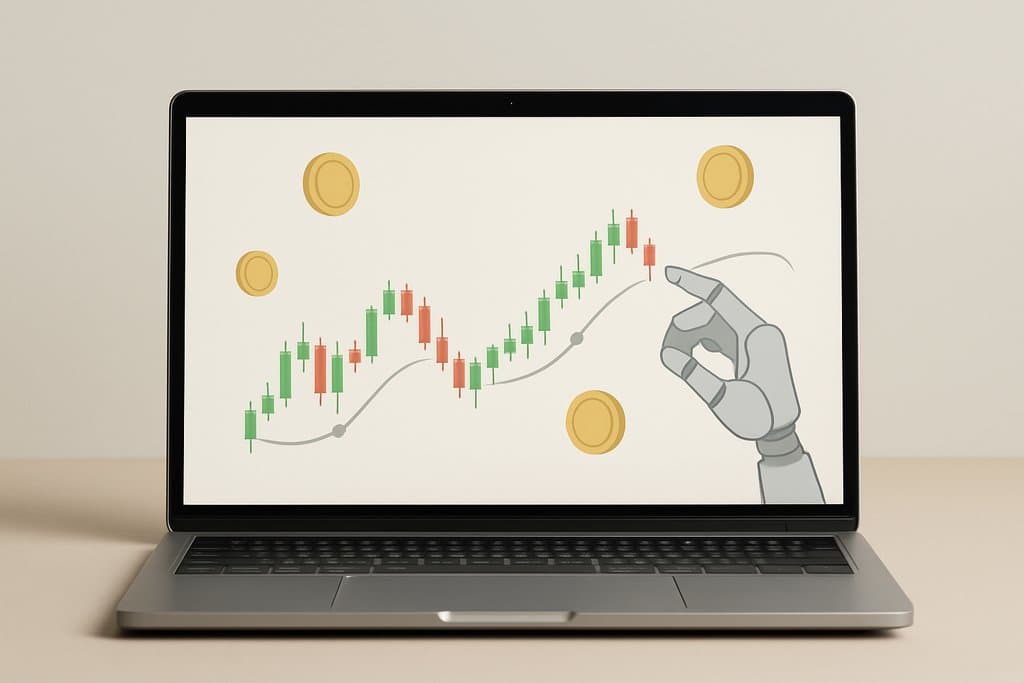
You want a crypto bot because the market doesn't sleep and your edge dies the moment you blink. The hard part isn't picking the cleverest model — it's choosing a setup whose execution, risk, and iteration speed all survive contact with live spreads.
This guide skips the listicle treatment. You'll learn what actually separates a usable bot from a marketing demo, which strategy families hold up across regimes, and a 7-step path to go from idea to a live bot you can monitor without babysitting.
What "best" actually means for a crypto trading bot
A cryptocurrency trading bot is software that connects to your exchange, evaluates rules against live data, and routes orders through API keys. The category covers everything from a $50/month grid bot to bespoke quant infrastructure. "Best" is contextual — the right tool for a beginner running a DCA plan is not the right tool for someone running market-making on perpetuals.
Cut through the noise by judging bots on six concrete criteria, not feature counts.
| Criterion | What to look for |
|---|---|
| Execution quality | Limit + market + post-only support, slippage controls, sub-second routing |
| Backtest realism | Models fees, slippage, and partial fills; supports walk-forward |
| Signal flexibility | Multi-timeframe, multi-asset, news/macro inputs, not just RSI |
| Risk controls | Per-trade stop, daily loss cap, global kill switch, exposure limits |
| Iteration speed | Time from idea to running bot — minutes, not weeks |
| Security | API keys with trading-only permissions, IP whitelisting, encrypted storage |
If a platform can't articulate how it handles all six, treat it like a toy.
Strategy families that survive in crypto
No bot is universally good. Each family fits a specific regime, and the best crypto operators don't pick one — they layer several with explicit conditions for when each runs.
Trend following and momentum
Buy when price closes above a moving-average cluster, when Supertrend flips bullish on a 2h chart, or when momentum confirms on a higher timeframe. Filter with RSI to avoid late entries. Exit with an ATR-based trailing stop or a moving-average cross-down. Works in directional regimes (BTC 2020–2021, parts of 2024) and bleeds in chop.
Mean reversion
Fade extremes when ranging. Buy a Bollinger Band touch or RSI < 25, size small, exit fast. Add a regime detector — when the daily ADX climbs above 25 or price clears a higher-timeframe Supertrend, switch this strategy off. Mean reversion in a breakout is how accounts die.
Breakout and volatility expansion
Detect compression (low ATR over N bars), wait for a volume surge, confirm direction on a higher timeframe, enter on the break. Use a structural stop at the prior swing. Crypto loves these setups around macro events and ETF flows.
Event-driven
ETF approvals, protocol upgrades, exchange outages, funding-rate flips. Event-driven bots need a reliable data source and tight risk wraps because the same headline can cause 50 different reactions. Most retail platforms can't do this. The ones that can compress hours of manual reaction time into seconds.
Market making and arbitrage
Not your first bot. These require inventory management, fee tier optimization, and exchange-risk hedging that most retail traders aren't ready for. Skip until you have at least one trend or breakout system running cleanly for months.
The best crypto trading bots aren't the cleverest — they're the ones with honest backtests, tight risk wraps, and operators who pause when something's off.
7 steps to ship a crypto bot with Obside
Obside is a financial automation platform that converts plain English into live alerts, automated orders, and full portfolio strategies. It won the Innovation Prize at the 2024 Paris Trading Expo and is supported by Microsoft for Startups. Here's the workflow.
1. Pick one objective, one asset, one timeframe. Don't build "a bot." Build a momentum bot on BTC/USDT, 2h chart. Constraints make decisions easy.
2. Describe the rules to Obside Copilot. Plain English:
Buy BTC when Supertrend turns bullish on 2h, RSI is below 70, and Supertrend is also bullish on 8h. Trail at 5 ATR. Close if 2h Supertrend flips bearish.
3. Add risk and sizing constraints.
Risk 1% of equity per trade. Daily loss cap at 3%. Maximum one open position.
These four lines are the difference between surviving a bad week and blowing up.
4. Backtest in seconds. Obside's engine runs your strategy across years of data with realistic fees and slippage. Read the equity curve, the drawdown profile, the trade distribution. If 80% of profit comes from one quarter, you've got a luck story, not a strategy.
5. Validate out of sample. Walk-forward across multiple windows. Test on assets the strategy wasn't tuned on (ETH if you built on BTC). Stability matters more than peak Sharpe.
6. Paper trade, then connect your exchange. Restrict API keys to trading only (no withdrawals). Start with size you can lose without flinching. Compare live fills to backtest assumptions for at least two weeks.
7. Monitor and refine. Use Obside's dashboard for positions, PnL, and decision logs. Add guardrails: pause on volatility spikes, kill switch on spread widening, alerts on consecutive losses.
You can extend the same workflow to event-driven logic. Examples that take 30 seconds to set up in Copilot:
- Alert me if BTC rises above $150,000 and daily volume doubles
- Buy $1,000 of BTC if price is below $100,000
- Sell all positions if the S&P 500 drops 10% in a day
- Buy $50 of BTC every Monday at 10:00
What separates the best bot setups from the rest
Capacity for honest validation. The single biggest predictor of a bot's longevity is whether its operator backtested with fees, slippage, walk-forward, and out-of-sample windows — or just optimized one curve until it looked beautiful.
Speed of iteration. Most traders fail not because their idea was bad but because their tooling made iteration slow. A bot you can update in 30 seconds gets ten times more shots at finding what works than one that needs a code rewrite.
Discipline around risk. Every successful long-running bot has the same three controls: per-trade stop, daily loss cap, global pause. Without them, one fat-fingered API call or one bad week wipes a year of returns.
Realistic expectations. A good crypto bot targets Sharpe 0.8–1.5 after costs and max drawdown under 25%. Anything claiming 200% annualized with no drawdown is selling you something.
What people get wrong about "the best" crypto bot
Mistake 1: Optimizing the chart, ignoring fees. A 4 bp edge dies fast when your slippage is 7 bp on a thin altcoin.
Mistake 2: One bot, one regime. Trend strategies bleed in chop. Mean reversion bleeds in breakouts. Build two, run both, let the regime filter decide which is live.
Mistake 3: Skipping paper trading. Paper isn't a formality. It's where you find your data has a 4-second lag and your orders get rejected during volatility.
Mistake 4: API keys with withdrawal permissions. If your platform is ever compromised, the difference between a bad week and total ruin is one checkbox.
Mistake 5: Trusting the Sharpe ratio alone. Look at drawdown depth, drawdown duration, and the in-sample vs out-of-sample gap. A 2.5 Sharpe with a 90% live/backtest divergence is overfit.
Ship your first crypto bot this week
Open Obside, connect a paper account, and describe a one-line strategy to Copilot. Backtest it across 2023–2025. If the results hold, copy the rules with one parameter changed and run a second variant. Pick the winner, deploy on paper, and re-evaluate in two weeks. That's it.
Obside compresses the work of choosing the best crypto trading bot into a workflow: describe, validate, deploy, monitor. The platform handles the plumbing — broker connections, alert wiring, backtest engine, news triggers — so the only thing that scales is your edge.
Educational content only. This is not investment advice. Trading involves risk, including possible loss of capital.
FAQ
A few hundred dollars is enough to start if your exchange supports small order sizes. Fees and slippage dominate at small size, so use this stage to validate your live fills match the backtest. Most retail strategies become meaningful at $2,000–$10,000, where 1% risk per trade represents enough capital for noise to average out.
Related articles
- Crypto Trading Bots: How They Work and Build One Fast
- Trading Bots Crypto: Choose, Build & Automate Strategies
- Algorithmic Trading: Build, Test and Automate
- Trading Automation: From Idea to Real-Time Execution
- Best Trading Bot: Choose, Test, and Automate Your Edge
- Backtesting Software: How to Pick, Use, and Trust It
Try Obside on your portfolio
Connect your broker and automate your strategy with a prompt.
Get started